
· by Michael Blair, Nashville's Junk Removal
A kitchen or bathroom remodel produces its debris in a burst: the tear-out week fills the garage and the driveway, and then the job slows down while the new work goes in. Most of what comes out can go on one truck, but not all of it, and Metro Nashville treats construction debris differently from household junk. Knowing what we take together, what has to stay separate and where each part is allowed to go keeps the pile from sitting in the driveway after the contractor is done. Our construction and renovation debris service is built around that sort.
What a remodel haul-away takes in one load
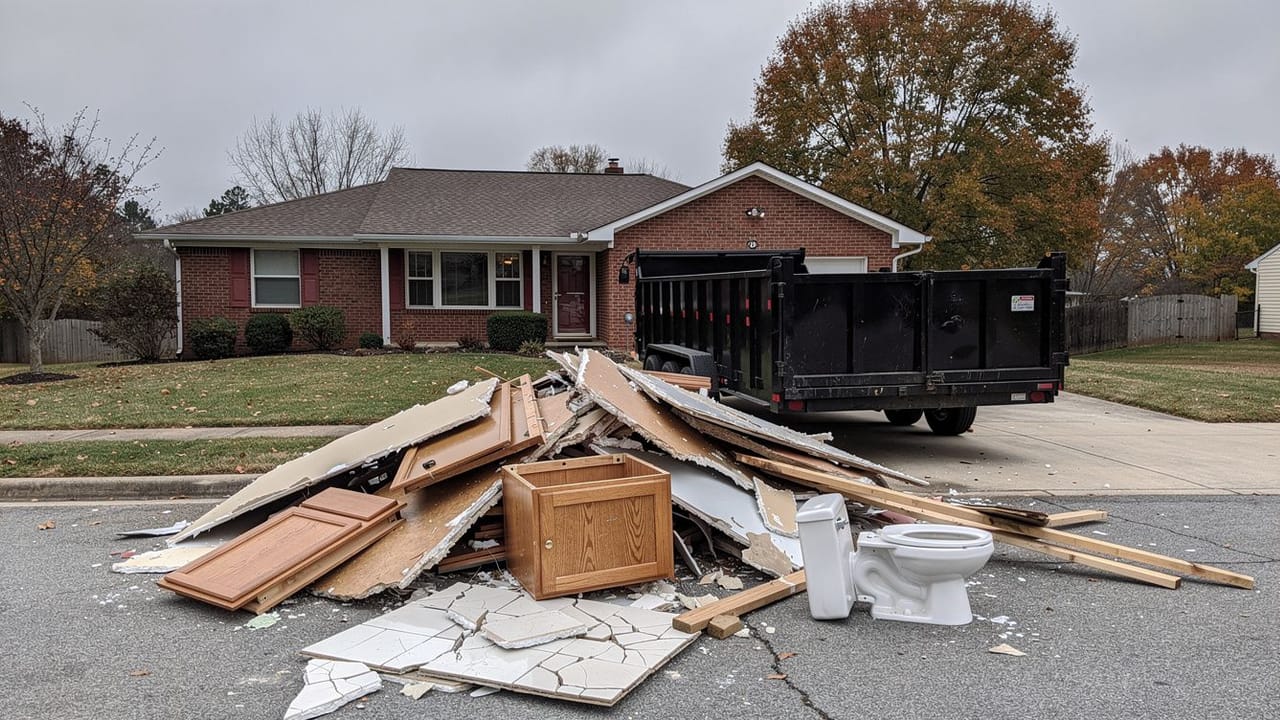
The bulk of a tear-out is ordinary construction debris, and it all rides together: drywall and plaster, framing lumber and trim, old cabinets and countertops, ceramic tile with its backer board, carpet and pad, vinyl flooring, doors, windows, and fixtures such as toilets, sinks, tubs and vanities. Roofing shingles from a small porch or addition job go in the same load. Our crews break cabinets and long lumber down so the truck packs tight, and we bag loose plaster and grout dust before it is carried through the house.
Weight matters more than volume with remodel debris. A truckload of wet plaster or tile weighs far more than the same space filled with cabinets, so we look at what the pile is made of before we quote it, not only how big it is. If your contractor is still working, we can come at the end of tear-out and again at the end of the job, so the driveway is clear while the finish work goes in.
What has to be kept separate
Four kinds of remodel waste do not go in the general pile. Concrete, brick and other masonry are heavy and go to a different place: Metro’s convenience center page lists brick, concrete, masonry, rock, rebar, roofing shingles, siding and plumbing among what its centers do not accept, and Metro’s bulky item page points larger loads to private processors that take concrete, brick, dirt and rock. Pressure-treated deck and porch lumber is kept out of anything that might be burned or chipped; the EPA’s page on chromated arsenicals says treated wood can usually go out as ordinary trash but should never be burned in a residential setting or reused as mulch.
Paint and liquids are sorted by type. Metro’s household hazardous waste page takes oil-based paint, thinner, stain, varnish, caulk and adhesives free at its East and Ezell Pike centers, up to 15 gallons or 100 pounds per household a month for Metro residents, and it does not take latex paint. Anything that may contain asbestos stops the job. In Davidson County the notice for a renovation that disturbs asbestos goes to the Metro Public Health Department’s Pollution Control Division on its demolition and renovation notification form, with a permit fee, and Metro Health Regulation No. 4 requires it at least ten working days before the work. We do not haul suspected asbestos; what junk removal will not take explains why.
- Concrete, brick, block and stone
- Pressure-treated lumber
- Paint, solvents, adhesives and other liquids
- Old flooring, ceiling texture or siding that may contain asbestos
A dumpster or a haul-away for a remodel
A roll-off dumpster suits a job where debris comes out steadily over weeks and someone on site will load it. It needs a place to sit. On your own driveway that is simple; on the street it is in the public right-of-way, and Metro’s transportation department issues a right-of-way permit for a dumpster or trailer through ePermits. Containers of two cubic yards or more also have to carry Metro’s private collection permit, which is the container company’s job to hold. We also set roll-off dumpsters when a job calls for one.
A haul-away suits a remodel where the tear-out happens in a few days, or where the debris is in a basement, an upstairs bath or a backyard the container cannot reach. Our crews do the carrying, so nothing has to be hauled across the yard and thrown over a dumpster wall, and the driveway is not tied up for the length of the job. Many remodels use both: a container for the long middle stretch and a crew for the heavy tear-out at the start and the leftovers at the end.
Where construction debris goes in Metro Nashville
Metro’s own pages send remodel debris to two places. Its Omohundro convenience center is the only center that takes construction and demolition material, for a fee and only in a small amount per visit, and Metro’s own pages give different limits for it, so check the current limit on the convenience center page before loading a car. Larger loads go to private processors and to landfills permitted for this waste. The state’s landfill permit page describes a Class IV facility as one that takes construction and demolition wastes, and Metro lists the Middle Tennessee Environmental Center at the Southern Services Landfill among the places larger loads can go.
Before any of it is landfilled, we pull out what can be reused. Scrap metal, from copper pipe and ductwork to old steel tubs and appliances, goes to a metal recycler. Clean, unpainted lumber and flattened cardboard from new cabinet and fixture boxes are kept apart from the mixed debris so they can be recycled. Cabinets, doors and fixtures in good shape can be donated instead of hauled; donate, recycle or dispose covers how to tell which is which. For a remodel inside the county, see junk removal in Nashville.
Sources
- Metro Nashville Waste Services, Convenience Centers — construction and demolition material accepted only at Omohundro; materials the centers refuse
- Metro Nashville Waste Services, Bulky Item Collection — destinations for larger construction and demolition loads, including processors and MTEC
- Metro Nashville Waste Services, Household Hazardous Waste — paint and solvents accepted, limits, latex paint excluded
- Metro Public Health Department, Notification of Demolition/Renovation form — asbestos renovation notice in Davidson County goes to Metro Pollution Control, with a permit fee
- Metro Public Health Department, Regulation No. 4 — notice at least ten working days before disturbing asbestos material
- US EPA, Chromated Arsenicals (CCA) — treated wood disposal, no burning, no mulch
- Metro Nashville Department of Transportation, Right of Way Permits — permit for a dumpster or trailer in the right-of-way
- Metro Nashville Waste Services, Private Collection Permits — permit for containers of two cubic yards or more
- Tennessee Department of Environment and Conservation, Landfill Permit — Class IV landfills take construction and demolition waste