
· by Michael Blair, Nashville's Junk Removal
An attic cleanout is a different job from a garage. Everything leaves through one small opening and down a ladder, often in Nashville summer heat, and the floor you are standing on may never have been built to be a floor. Here is what the code says an attic is designed to carry, what that means for getting things out, and when to hand the job to a crew. The garage side of this work is in garage and shed cleanouts.
How much weight can an attic floor hold?
Often less than people think. Table R301.5 of the 2018 International Residential Code as published for Tennessee (the text we read on UpCodes) sets minimum design live loads: 10 pounds per square foot for an uninhabitable attic without storage, 20 for an uninhabitable attic with limited storage, and 30 for a habitable attic or one served by fixed stairs. Those are design minimums for new construction, not a rating stamped on any particular house, and an older house was built to whatever applied when it went up.
The table’s footnotes show how little of a typical attic counts as storage. An attic is treated as without storage where the clear height between the joists and the rafters is 42 inches or less, or where the trusses leave no room for a 42 by 24 inch rectangle. Even where storage is allowed, the 20-pound figure applies only to the members near an opening at least 20 by 30 inches with 30 inches of clear height, laid at a slope of no more than 2 in 12, and with insulation shallower than the members; the rest of that attic is designed for 10.
What that means for getting things out
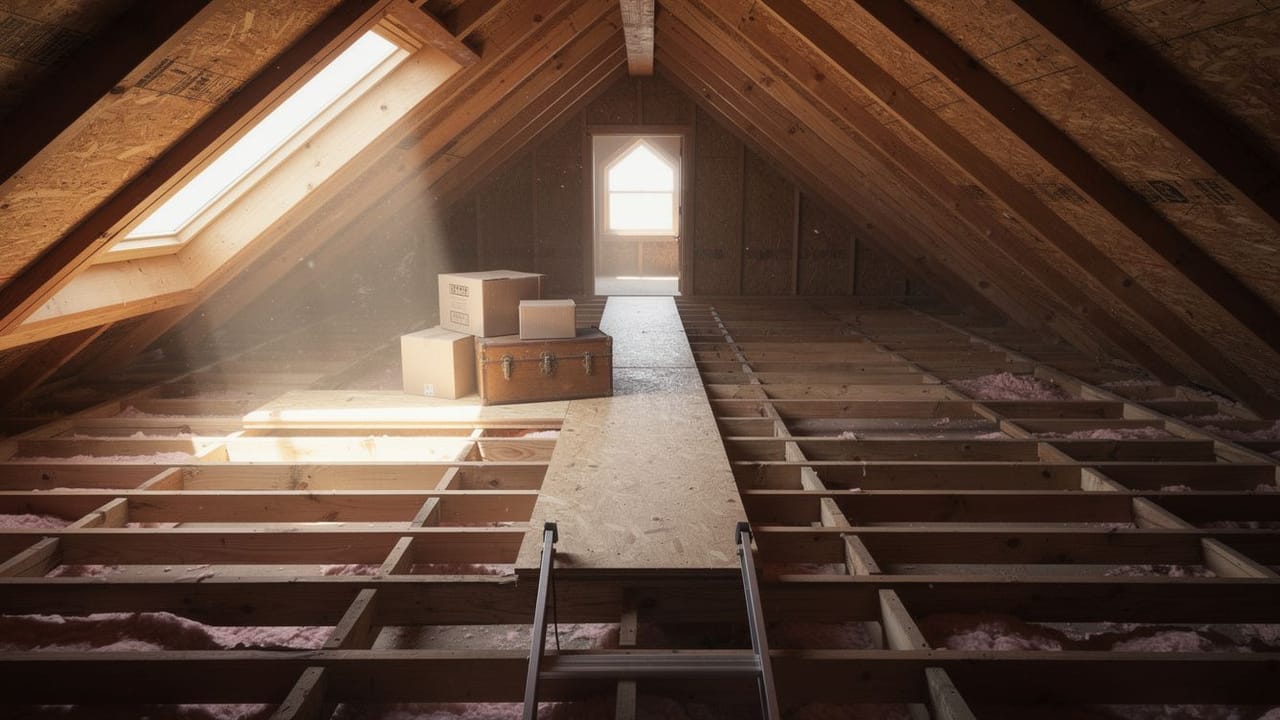
The weight to worry about is the weight in one place. Boxes tend to pile up right beside the opening, because that is where they were easiest to set down, and that is the spot we keep clear. Our crews do not stack things up in the attic to sort them. Items move to the opening in small loads and go straight down, and the sorting happens below, in the garage or the driveway.
Footing comes next. The gaps between joists are the ceiling of the room below, so we step and kneel only on the joists or on boards laid across them, and we lay boards down where there are none. Anything too heavy to hand down in one piece gets taken apart in the attic if it comes apart. If you are getting the house ready for us, preparing for junk removal covers the rest of the day.
What is the safe way to carry things down an attic ladder?
Hand things down rather than carry them down, one manageable piece at a time. Our crews work it with one person in the attic and one at the foot of the ladder, so nobody climbs with a load and the climber always has a hand free for the ladder.
- One person above passes, one person below receives
- Boxes small enough to hand down at arm’s length
- Nothing carried that takes both hands on the way down
- Heavy pieces taken apart above, or left until they can be
- The area under the opening kept clear so there is somewhere to set things
Who clears an attic out?
You can, for a few light boxes on a cool day. A crew makes more sense when there is a lot of volume, heavy furniture, a narrow opening or a deadline, and when the job lands in summer. National Weather Service climate figures for Nashville put the average July high at 90.9°F and count an average of 49 days a year at 90°F or above, 17 of them in July and 14 in August. That is the temperature outside, before you climb under the roof, and it is why we start attic jobs at first light in those months.
Our garage and attic cleanouts include the carrying, the loading and the hauling away, with what can be donated or recycled sorted out of the load. We work in Franklin and across Middle Tennessee, and what drives a junk removal price explains how the job is quoted. When the attic is ready to go, tell us what is up there.
Sources
- 2018 International Residential Code as published for Tennessee, Table R301.5 (UpCodes) — Minimum attic live loads of 10, 20 and 30 psf; footnotes defining attics without storage and with limited storage
- National Weather Service Nashville, Nashville climate — Average July high 90.9°F; 49 days a year at 90°F or above, 17 in July and 14 in August
FAQ
Clearing Out an Attic: What the Floor Will Carry — questions
How much weight can an attic hold?
The 2018 International Residential Code as published for Tennessee designs uninhabitable attics without storage for 10 pounds per square foot and those with limited storage for 20. Those are design minimums for new construction, not a rating for your house. Unless your attic was built as storage or living space, treat its floor as light-duty.
How do you clean out an attic?
Work from the opening outward, bringing items to the hatch in small loads and handing them straight down rather than stacking them in the attic. Step only on the joists or boards laid across them, never between. Do the sorting below, in the garage or driveway, where the floor, the light and the room are better.
Do I need to hire someone to clean out an attic?
Not for a few light boxes. A crew makes sense when there are heavy pieces, a lot of volume, a narrow opening or a summer schedule; National Weather Service figures show Nashville averages 49 days a year at 90°F or above. A crew also loads, hauls and sorts everything in one visit.
What should you do before an attic cleanout?
Clear the floor under the attic opening and a path to the door, decide what is staying, and set aside anything fragile or valuable. Check that the ladder opens fully and sits steady. Plan to sort on the ground rather than in the attic, where space, light and footing are all limited.
How do you get heavy items down from the attic?
Take them apart in the attic if they come apart, then hand the pieces down with one person above and one at the foot of the ladder. Nothing that takes both hands should be carried while climbing. A piece that will not fit through the opening stays up there until it can be taken apart.