
· by Michael Blair, Nashville's Junk Removal
A shed that has stopped keeping the rain out usually goes one of two ways: it gets fixed, or it comes down and leaves room for something else. When it comes down, the tearing apart is the quick part. What takes thought is what is inside it, what is wired to it, what the wood and the panels are made of, and whether anyone has to approve it first.
Here is how we approach shed removal around Middle Tennessee, and the federal and Metro guidance behind each step.
What has to happen before a shed comes down?
Before a shed comes down, it has to be emptied, disconnected from any power, and looked over for what it is made of. Emptying comes first because a shed is usually a storage room as much as a building, and the contents go a different way than the walls. Our post on clearing a garage that has filled up covers that half of the job, and paint, fuel and pool chemicals follow the rules in our post on what junk removal companies will not take.
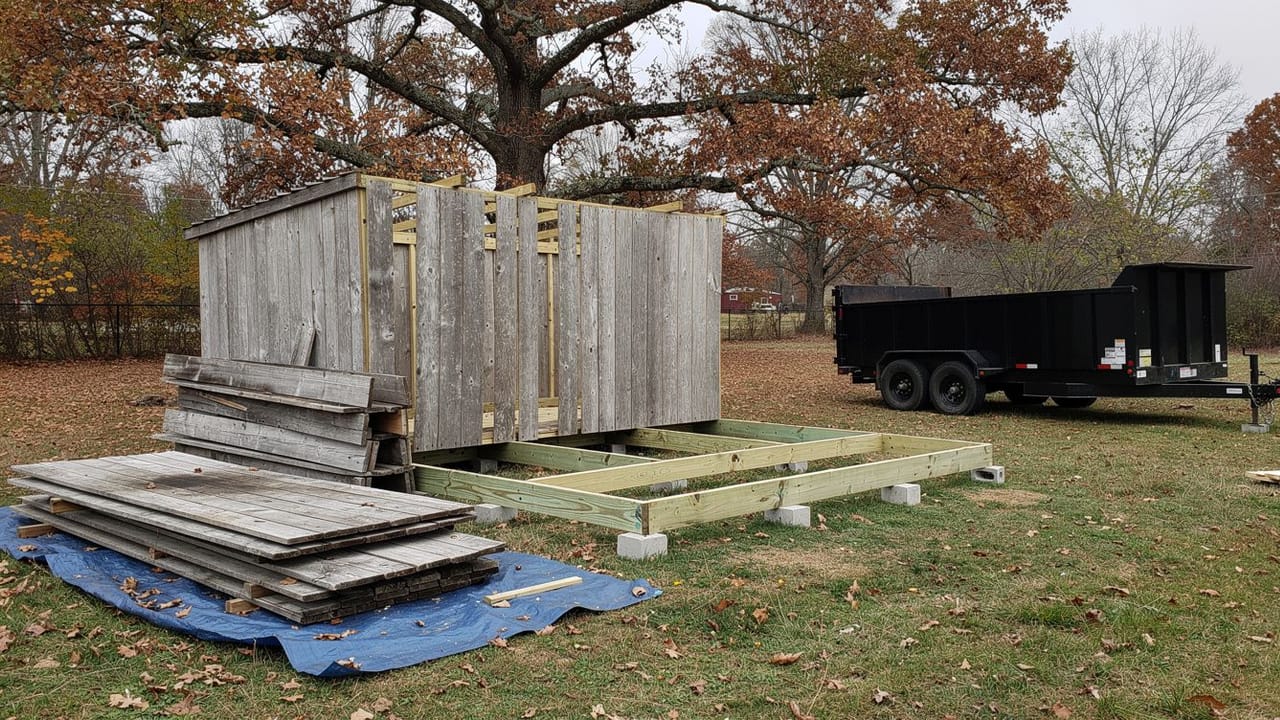
If the shed has a light or an outlet, the circuit feeding it needs to be shut off and disconnected at the house by an electrician before anyone pulls a wall, since a cable buried across the yard is easy to forget. Water lines to a potting bench or a sink get shut off and capped the same way. Once it is empty and dead, we take the shed down in sections, roof first, and sort the pieces as they come off.
Do you need approval to remove a shed in Nashville?
Whether you need approval to remove a shed depends on where the property sits, and in a Metro historic overlay it starts with a call to the historic zoning staff. The Metro Historic Zoning Commission’s page on applying for a preservation permit asks owners in an overlay to contact the commission to confirm whether it needs to review a project, lists outbuildings among the work it reviews, and says most projects also need a building permit from Metro Codes.
Outside an overlay, we have not found a Metro rule written specifically for taking down a small shed, so we do not claim one either way. Ask Metro Codes, or the codes office of your own city if you live in Franklin, Murfreesboro or another town with its own, and check any HOA covenants. If you plan to put up a new building where the old one stood, the permit for that is a separate question with its own rules.
Can you burn the wood from an old shed?
You should not burn the wood from an old shed if any of it is pressure-treated, and on most sheds the floor frame and skids are. The EPA’s page on chromated arsenicals (CCA) says CCA-treated wood was used in homeowner structures such as decks and playsets before 2004, and that makers stopped producing it for homeowner uses in December 2003. It says that CCA wood, and treated wood of any kind, should not be burned at home, so nobody breathes the toxic chemicals in its smoke and ash.
The same page says a household can usually put CCA-treated wood out with ordinary trash, but that state and local governments may have their own instructions. That is how we handle it: treated lumber goes in the load to the landfill or transfer station, not into a burn pile or a fire pit, and it is kept out of any wood we would otherwise send for reuse. Plain untreated boards in good shape, and metal panels and hardware, can often go elsewhere, as our post on donating, recycling or disposing explains.
What about old roof and wall panels?
Old roof and wall panels whose makeup nobody knows get tested before they are broken, because asbestos cannot be identified by eye. The EPA’s page on protecting your family from asbestos says you generally cannot tell whether a material contains asbestos by looking unless it is labeled, and that if in doubt you should treat it as asbestos and leave it alone. It says sampling should be done by a trained and accredited asbestos professional, not by the homeowner.
The EPA adds that asbestos materials in good condition are unlikely to release fibers, and that cutting, breaking, sanding or tearing them is what does. So a shed with gray panels of uncertain age gets sampled first, and anything that tests positive is handled by an accredited contractor, not torn off by a crew. Most sheds are plain wood, metal or vinyl, and those come down the same day. A concrete slab under the shed is a separate job on our light demolition list. To get a shed looked at, send us photos of the outside, the floor and any panels.
Sources
- U.S. Environmental Protection Agency, Chromated Arsenicals (CCA) — CCA-treated wood used in homeowner structures before 2004; manufacturers stopped homeowner-use products in December 2003; do not burn treated wood in a residential setting; households can usually dispose of it as ordinary trash; check state and local guidance
- U.S. Environmental Protection Agency, Protect Your Family from Exposures to Asbestos — Asbestos cannot generally be identified by sight unless labeled; if in doubt treat it as asbestos and leave it alone; sampling by a trained and accredited professional; fibers released when material is cut, sanded, broken or torn
- Metro Nashville Historic Zoning Commission, Apply for a Preservation Permit — Contact the commission to confirm whether a project needs review; outbuildings and demolition among the work reviewed; most projects also need a Metro Codes building permit
FAQ
Shed Removal: Tearing Down and Hauling an Old Shed — questions
Can you burn pressure-treated wood from an old shed?
No. The EPA says CCA wood and other treated wood should not be burned at a home, because its smoke and ash can carry toxic chemicals. Wood treated with CCA was sold for homeowner use until the end of 2003, so an older shed floor or frame may be CCA. Send it out with the trash instead.
Can old treated wood go in the regular trash?
Usually, according to the EPA, which says households can generally dispose of CCA-treated wood as ordinary municipal solid waste. It adds that state and local governments may have their own instructions for treated wood, so check with your local waste program before setting a large pile at the curb.
Does a shed need to be emptied before it is removed?
It helps, and either way the contents are sorted before the walls come down. Furniture, tools and boxes can go out with the shed, but paint, fuel, pool chemicals and pesticides follow their own disposal rules. Power to the shed should be disconnected at the house by an electrician before the work starts.
How can you tell if old shed panels contain asbestos?
Usually you cannot by looking. The EPA says that unless a material is labeled, you generally cannot tell whether it contains asbestos, so treat it as if it does and leave it alone. A trained and accredited asbestos professional should take samples; the EPA does not recommend sampling it yourself.
Does removing a shed in a historic district need approval?
Check before you start. The Metro Historic Zoning Commission asks owners in a historic overlay to contact it to confirm whether a project needs its review, and it reviews work on outbuildings. It notes that most projects also need a building permit from Metro Codes, which can be applied for at the same time.